Quarterly_Update_Cover_Q1_2026
Video

Numbers and Narratives: Q1 2026

What Changed Since Q4 2025

This quarterly series is designed to provide perspective and keep you informed on global markets and economic conditions. Like last quarter, this update is paired with a short video, so you can engage with the content in the way that works best for you.

Hard to believe these stories all hit the wire in Q1:

  • “U.S. forces capture Maduro in Caracas, bring him to New York to face drug trafficking charges” – Reuters (Jan. 3, 2026)
  • “Fed Chair Powell says he’s under criminal investigation, won’t bow to Trump intimidation” – CNBC (Jan. 12, 2026)
  • “Trump hits 8 U.S. allies with tariffs in push for Greenland deal” – NBC News (Jan. 18, 2026)
  • “New Research: Proposed 10% Credit Card Rate Cap Would Eliminate 74–85% of Open Accounts” – American Bankers Association (Jan. 20, 2026)
  • “Private credit stocks plummet on concern about exposure to software industry disrupted by AI” – CNBC (Feb. 3, 2026)
  • “US and Israel launch strikes on Iran; Khamenei killed in assassination” – Reuters (Feb. 28, 2026)

Last quarter was all about the numbers being noticeably disconnected from the narratives. Stocks and bonds ended the quarter meaningfully higher, inflation was cooling, and growth improved. The underlying economic data appeared constructive, even as consumer sentiment surveys were sitting at levels not seen since the global financial crisis.
Source: YCharts, TFO Calculations, University of Michigan – 11/30/1952 – 12/31/2025

This quarter, the numbers and the narratives are more in sync: negative headlines, lower market prices. That is a change from Q4.  Based on historical experience, many would have expected equities and bonds to be down far more than they are under conditions due to the U.S. war in the Middle East and oil prices above $100 per barrel by the end of the quarter.

At its worst point, the S&P 500 was down 9% from its peak in Q1, which doesn’t feel great.1  By comparison, the average intra‑year drawdown for the S&P 500 going back to 1950 is about 14%, putting this year’s pullback below historical norms.”

We’re being reminded of something we talk about often at TFO, real-time: risk and return are related. Historically, bearing uncertainty in stock and bond markets has been associated with higher expected returns, though outcomes can vary. Periods of price pressure are a regular feature of markets and tend to coincide with periods of adjustment as conditions evolve.

The Numbers That Matter

The Markets

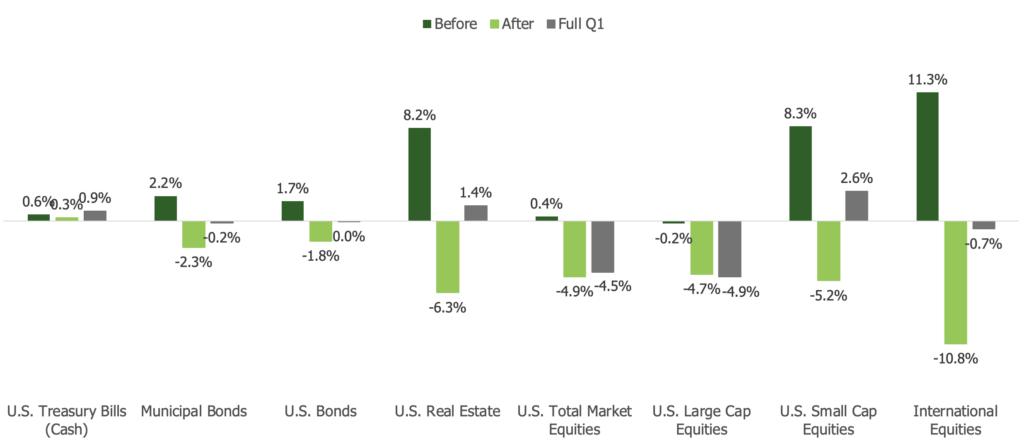
Global equities were down 2.2% in Q1. Small caps +2.6% and real estate +1.4% added to performance.2

Strong operating results for companies pushed corporate earnings and profit margins higher. As of the latest quarterly results, the S&P 500 reported growth in earnings of 14%, the 5th straight quarter of double-digit growth; profit margins are now 13.2%, surpassing the 5-year average of 12.1%.3

Fixed income was flat on the quarter, even as treasury yields rose (prices move inverse to rates). Higher bond yields continue to provide a cushion for bond investors. Following the dramatic reset in global bond yields in 2022, bond returns have steadied, up 5.53%, 1.25%, and 7.3% in 2023, 2024, 2025, respectively.4

Source: YCharts, 12/31/2025-3/31/2026, Pre/Post War Date 2/28; Indices – Bloomberg US Treasury Bills 1-3 Month, Bloomberg Municipal Bond, Bloomberg US Aggregate, MSCI USA, MSCI USA Large Cap, MSCI USA Small Cap, MSCI US IMI Real Estate 25-50, MSCI ACWI Ex-USA Net

The Economy

Economic growth was revised lower in Q4 2025 (reported in Q1 2026). U.S. real GDP grew at a 0.7% annual rate, down from 4.4% in the prior quarter, with downward revisions to net exports, personal consumption, business investment, and government spending.5

Inflation continued to cool through February’s report (January data). The U.S. Consumer Price Index (CPI) slowed to 2.4%, continuing its trend lower from the 9% peak reached in mid-2022. Importantly, this reading predates the Iran War. The full impact on prices won’t be captured until April’s report (March data).6

The Narratives That Matter

2026 started with a bang. So many narratives, but two stick out in terms of market impact: AI disruption and the Iran War. These do carry weight. Let’s touch on AI first.

AI Disruption

In Q4, we wrote about the wave of AI bubble headlines: companies overinvesting, valuations running ahead of reality. Then, almost overnight, the narrative flipped. By early 2026, the concern was no longer that AI was overhyped. It was that AI disruption was coming faster than markets had priced in.

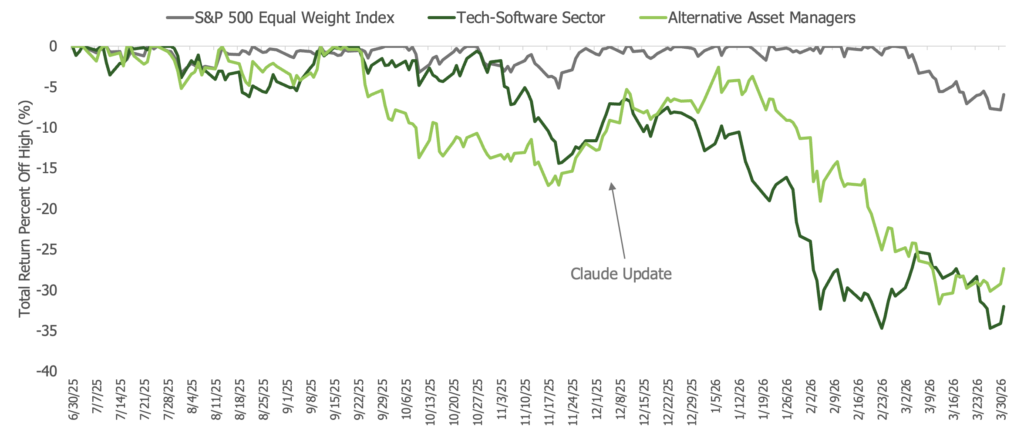
One of the clearest ways to see this narrative’s impact on the market is by looking at software stocks (e.g., Salesforce, Intuit, etc.), or stocks of companies that lend to the software industry (e.g., Blackstone, Blue Owl, etc.). Software-adjacent investments are widely seen (right now) as more exposed to step function improvements to AI; as tool capabilities improve, perceived safety of future earnings for such companies fall.

A ‘direct hit’ landed in late November of 2025, when Anthropic released an update to its Claude tool that meaningfully advanced the case for true agentic AI, meaning AI that can perform complex, multi‑step, autonomous capabilities. The move intensified in Q1.

Whether or not that capability is fully here yet, markets started pricing in the possibility that it will be, and sooner than what was priced in. The chart below shows that divergence clearly. Both industry groups are down roughly 30% from their highs.7

Source: YCharts, 6/30/2025-3/31/2026, iShares Expanded Tech-Software ETF (IGV), Invesco S&P 500 Equal Weight ETF (RSP), VanEck Alternative Asset Manager ETF (GPZ). Note: showing equal weight index as it’s a better representation for the average stock independent of market capitalization.

Broad AI adoption will have an impact, both on the nature of work and society more broadly, that is clear. What remains foggy is the path we take to get there. It’s way too early. But reality will likely land somewhere in the middle of those laying out a dystopian future and those brushing it off as just noise.

Though this narrative does matter, it’s still mainly expectations-based (narrative > numbers). We’re all hearing the stories. But it’s important to keep an open mind on the range of potential outcomes, both negative…and positive.

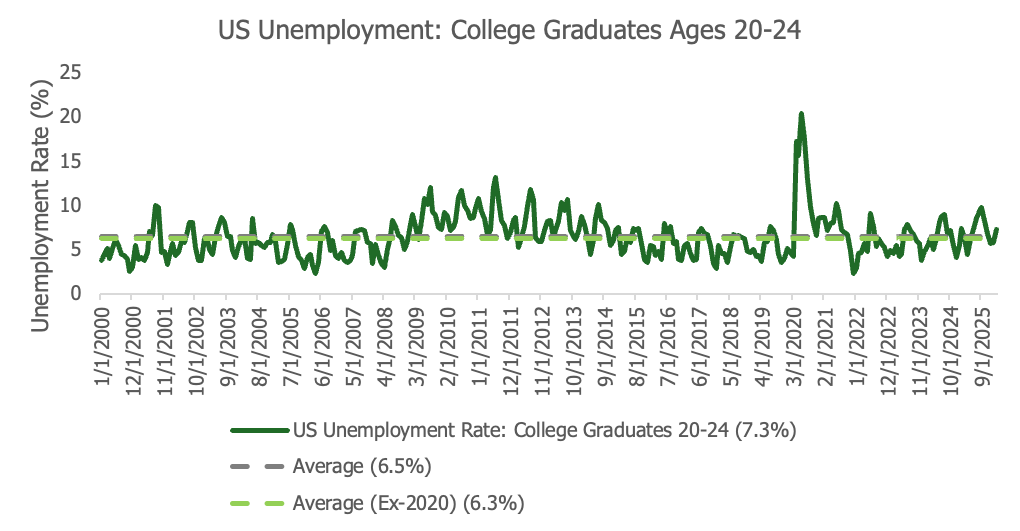
One example: you’re sure to hear anecdotes that recent college graduates can’t find employment as they’re being replaced by AI tools. We just haven’t seen it yet in the hard data.

Recent college graduate unemployment has not broken from its long-term range, even after nearly four years of broad AI adoption since the launch of ChatGPT in late 2022.

Sources: TFO Calculations, US Bureau of Labor Statistics (BLS), Macrotrends, 9/30/2010-2/28/2026

What’s more likely is that skills change as the economy evolves. Or a step further, the path to employment changes.

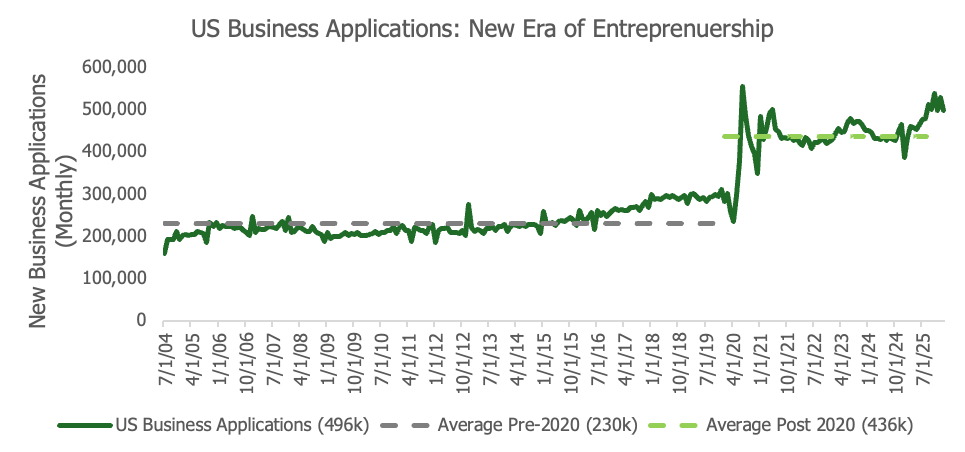
Take another example: new business applications (i.e., entrepreneurship). Since the pandemic, monthly business applications have doubled and keep trending higher following advancements in AI tools.

Sources: TFO Calculations, Census Bureau, 7/31/2004-2/28/2026

Advancements in AI have made it easier than ever for risk-takers to innovate and create new businesses. This is the beauty behind our economy. It evolves, morphs, and participants, like all of us, are financially incentivized to adapt.

The AI disruption narrative hit specific corners of the market hard. But it wasn’t until the Iran War that the selloff broadened to the average stock.

The Iran War

The main release valve for markets to price risk around conflict in the Middle East is the price of oil. And oil price shocks don’t happen in isolation. There are ripple effects. The global macro trends that seemed rock solid coming into the quarter flipped quickly once the war began.

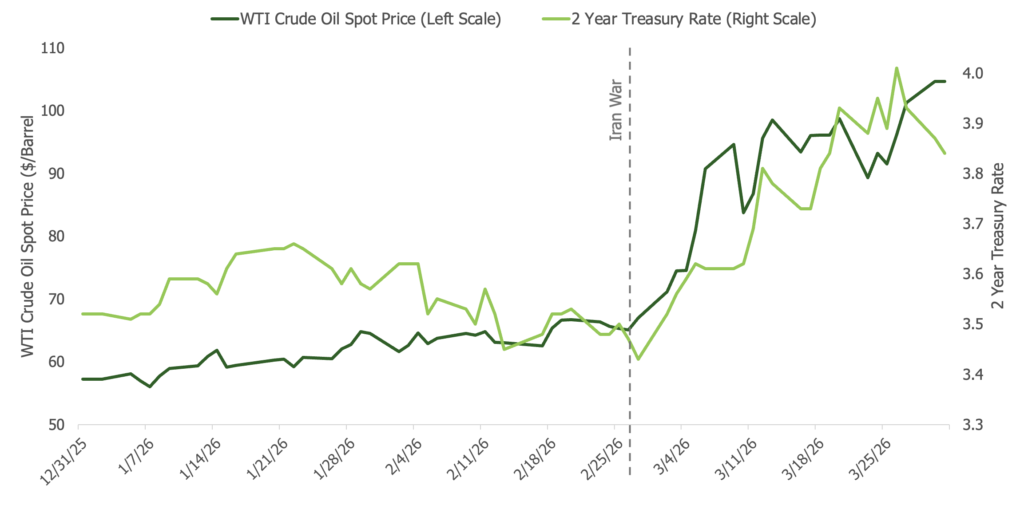
The price of U.S. produced oil started the quarter at $57/barrel and ended at $105/barrel. Given oil’s influence on consumer prices, interest rates moved higher along side oil, with 2-year Treasury rates up from 3.5% to 3.8%.

Source: YCharts, 12/31/2025-3/31/2026; Indices – WTI Crude Oil Spot Price (Oil), U.S. 2 Year Treasury Rate (Rates)

To put the speed of that move in context: oil briefly dipped 2% on the year before ending Q1 up 82%. The ripple effects were just as swift. The U.S. dollar swung from down 2% to up 3% on the quarter, a large move for the world’s reserve currency. Gold, which had been up 25% on the year, pulled back to +8% by quarter’s end. Global stocks fell from +5% to -2.2%, and bonds from +1.8% to flat on the year.8

Beyond inflation expectations, interest rates, and currencies, higher oil prices and geopolitical conflict can influence other variables as well, such as risk sentiment, credit spreads (compensation for taking on fixed income credit risk), and equity valuations (price investors pay per dollar of earnings of a company).

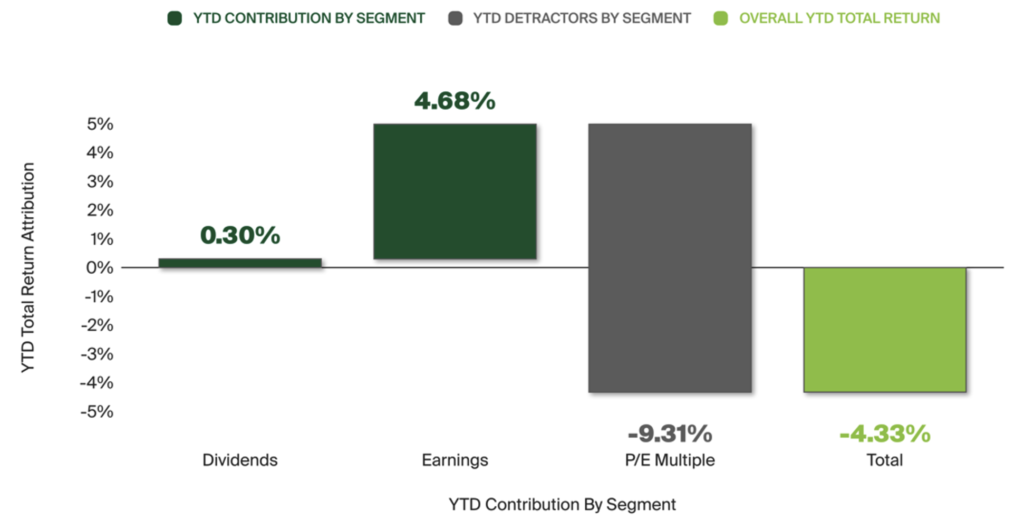
Take equity valuations, as a single example. You can break equity returns into three components: earnings, dividends, and valuations (price to earnings multiples). Each can play a different role at times. For Q1, even though total returns for the S&P 500 Index were down 4.33%, dividends and earnings (based on companies’ cash flows and results) were meaningfully positive, which is exactly what you want to see.

Source: © Exhibit A, FactSet Research Systems Inc., Standard & Poor’s, 12/31/2025-3/31/2026

However, the change in valuation multiples took back all those gains, and then some. Investors simply took down the price they were willing to pay per dollar of earnings, even if they were growing. That is the more emotional component of returns, and it is the one that dominated the headline number in Q1.

What This Means for Long-Term Investors

Political polarization is intensifying, social media is getting louder, and news cycles never stop. That combination makes it harder than ever to stay focused on what matters. The noise is relentless, and the cost of reacting to it keeps rising.

That is what this Numbers & Narratives series is all about. We want to slow down and provide perspective. Not because headlines don’t matter, but because today’s news cycle is fundamentally different than anything that came before it.

For long-term investors, the principles remain simple, even if execution is not. Stay invested if it aligns with your plan. Diversify across asset classes and global regions. Be mindful of costs and taxes, which compound quietly over time. And resist the urge to let short-term narratives override long-term discipline.

1 TFO Calculations, YCharts, S&P 500 Index Total Return Percent Off High, as of 3/31/2026

2 YCharts, MSCI ACWI Index, MSCI US IMI Real Estate 25-50 Index, MSCI USA Small Cap Index, data as of 3/31/2026

3 FactSet, fiscal Q4 2025 results reported in March Q1 2026

https://insight.factset.com/earnings-insight

https://insight.factset.com/sp-500-profit-margins

https://csimarket.com/Industry/industry_Profitability_Ratios.php?sp5

4 YCharts, Bloomberg U.S. Aggregate Index, data as of 12/31/2021-3/31/2026

5 YCharts, Bureau of Economic Analysis, US Real GDP QoQ Annualized Growth, 12/31/2025

6 YCharts, Bureau of Labor Statistics (BLS), as of 2/28/2026

7 TFO Calculations, YCharts, iShares Expanded Tech-Software ETF (IGV), VanEck Alternative Asset Manager ETF (GPZ), data as of 6/30/2025-3/31/2026

8 TFO Calculations, YCharts, 12/31/2025-3/31/2026 – Gold priced USD, WTI Crude Oil Spot USD, ICE US Dollar Index, MSCI ACWI, Bloomberg US Aggregate Index.

Advisory services provided by TFO Wealth Partners, LLC. We believe this information provided is reliable, but do not warrant its accuracy or completeness. This material is provided for informational purposes only.

Asset allocation and diversification do not assure or guarantee better performance and cannot eliminate the risk of investment losses. Past performance may not be indicative of future results. Therefore, no current or prospective client should assume that the future performance of any specific investment or strategy will be profitable or equal to past performance levels. All investment strategies have the potential for profit or loss. Different types of investments involve varying degrees of risk, and there can be no assurance that any specific investment will either be suitable or profitable for a client’s portfolio. There are no assurances that a portfolio will match or outperform any particular benchmark.

521aWP – 2026.04

white-dots white-dots

Ready to review your current wealth plan?

Getting started is easy. Set a time to talk.

Let’s Talkarrowarrow