Quarterly_Update_Cover_Page
Video

Q4 2025: A New Quarterly Look Past Market Headlines with Matt Sheridan

What Changed Since Q3

This quarterly series is designed to keep you informed on global markets and economic conditions, while also providing context and perspective along the way. Like last quarter, this update is paired with a short video, so you can engage with the content in the way that works best for you.

Q4 was a busy quarter by any measure. It began with the longest government shutdown in U.S. history, included multiple interest rate cuts by the Federal Reserve, saw a brief but sharp equity market pullback tied to concentration and AI bubble concerns, and unfolded against a steady drumbeat of geopolitical headlines.

Yet despite those narratives, markets remained resilient.

What stood out most was the growing disconnect between how people feel about the economy and what the underlying data continues to show. Measures of consumer sentiment hovered near levels last seen during major crises, even as global stock markets pushed to all-time highs, supported by strong corporate profits and improving inflation trends.

That gap between perception and reality became one of the defining features not only of the quarter, but of 2025.
The Numbers That Mattered

The Markets

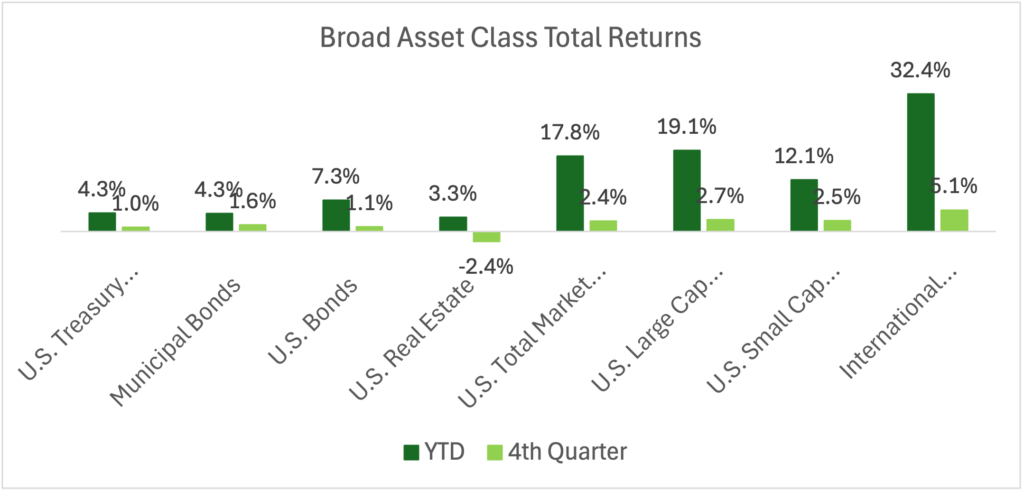
Global equities gained 3.2% in Q4 and over 22% in 2025. Foreign stocks contributed meaningfully to this growth, up over 32% on the year, reinforcing the benefits of global diversification.1

Strong operating results for U.S. companies pushed corporate earnings and profit margins to new highs. As of the latest quarterly results, earnings for companies in the S&P 500 Index rose by more than 12%, while profit margins expanded above 13%, both exceeding long-term averages.2

Fixed income also posted positive returns, rising 1.1% in Q4 and 7.3% in 2025.3 Bond yields were a key driver. 10-year Treasuries and high-grade corporate bonds entered 2025 with yields of approximately 4.6% and 5.4%, respectively, providing a much stronger income foundation than investors had grown accustomed to in prior years.4

Source: YCharts, FTSE Global All-Cap Index, data as of 12/31/2025, YCharts, Bloomberg U.S. Aggregate Index, data as of 12/31/2025

The Economy

Economic growth remained strong. U.S. real GDP grew at a 4.3% annual rate in the third quarter (reported in Q4) marking the fastest pace in two years despite tariff-related concerns earlier in the year.

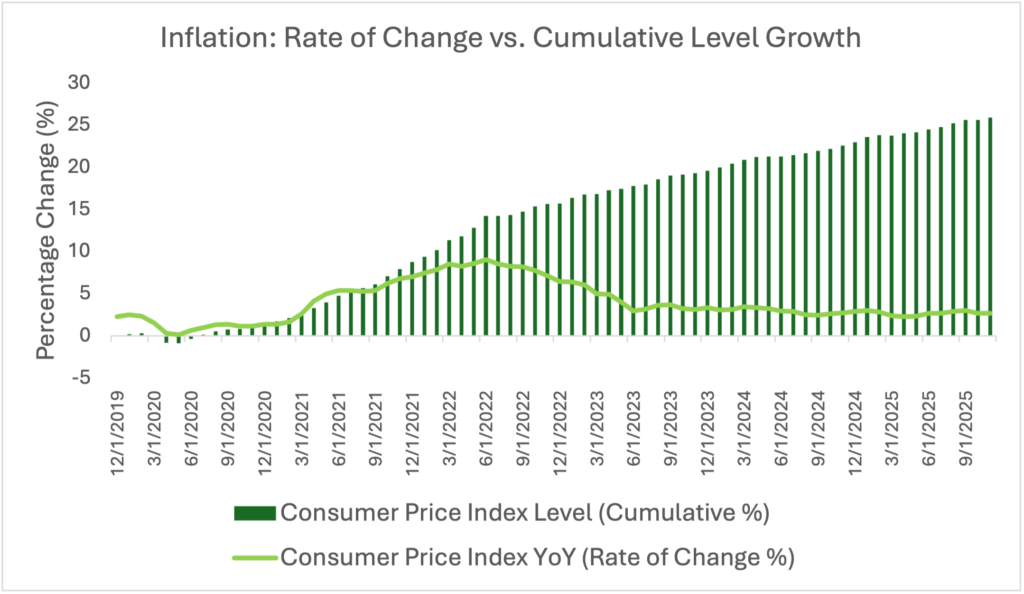
Inflation continued to cool. The U.S. Consumer Price Index slowed to 2.7%, down from the 9% peak reached in mid-2022. While the rate of inflation is coming down, it is worth remembering that households experience inflation through cumulative price changes. Since the start of the decade (i.e., post-pandemic era), overall prices have risen by roughly 26%.5

Source: YCharts, Bureau of Labor Statistics (BLS), as of 11/30/2025

The Narratives That Circulated

Stocks up, bonds up, growth up, inflation slowing; you wouldn’t know it from reading the headlines.

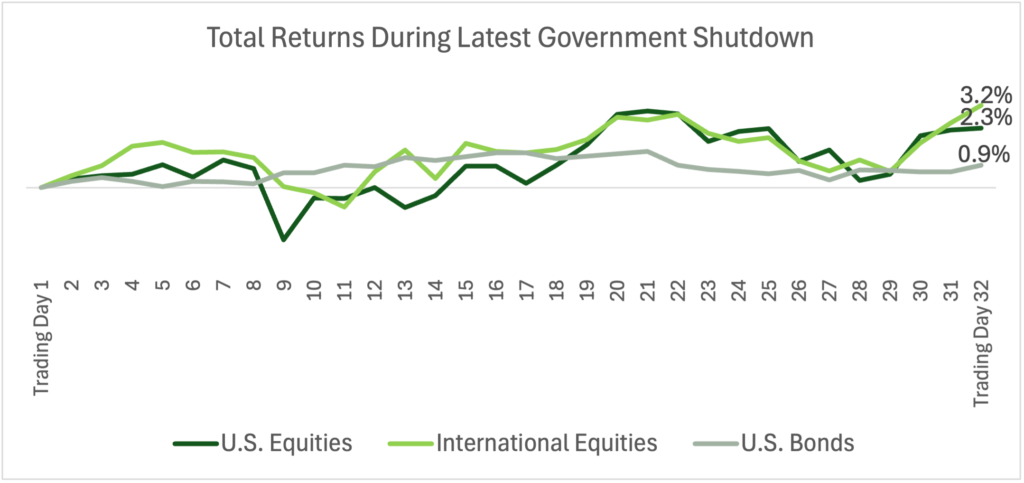
The government shutdown dominated news coverage early in the quarter. It ultimately lasted 43 calendar days, the longest on record. While disruptive and frustrating, shutdowns are not rare. There have been 11 since 1980, and only 3 coincided with negative stock market returns.6

This time, both stock and bond markets held up just fine, which is another reminder not to let political headlines drive long-term investment decisions.

Market concentration fears intensified as the quarter progressed. We discussed this in Q3, but the narrative gained momentum in Q4, contributing, along with AI-related bubble concerns, to a brief but sharp 5% market pullback in November.

There is no denying that markets are more concentrated today. The top 10 stocks now make up roughly 40% of the S&P 500 Index, and the top 25 account for just over 50%. That sounds alarming until you zoom out. In the next nine largest stock markets outside the U.S., including the United Kingdom, Canada, Germany, and France, concentration is even higher, averaging 48% in the top 10 and 70% in the top 25.7

This is not a uniquely American topic.

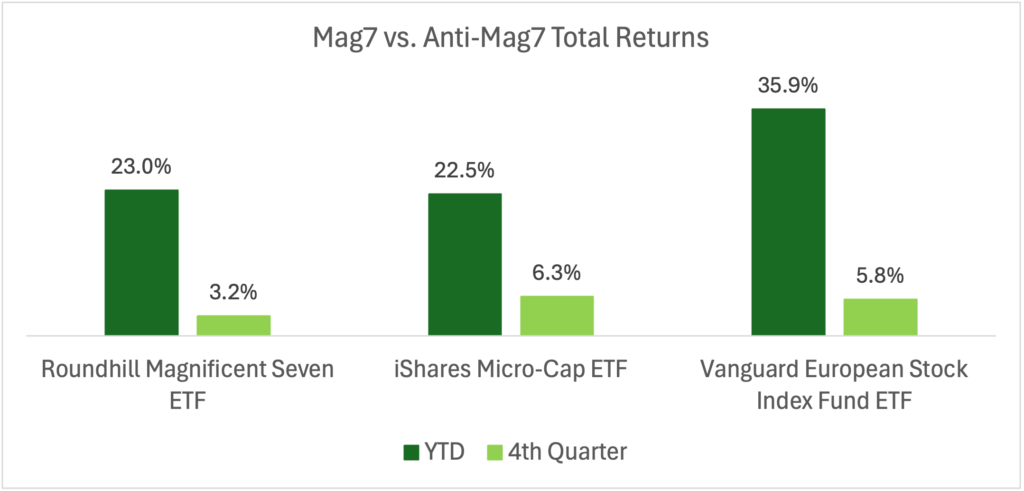
Contrary to headlines, performance beneath the surface broadened during the quarter. U.S. micro-cap stocks and European equities both outperformed the so-called “Magnificent Seven” (Mag7) in Q4. For 2025, micro-cap returns were at parity with the Mag7, while European equities outpaced them by more than 12%.8 These two areas represent the exact opposite side of the concentration debate.

Source: YCharts, TFO Calculations, MAGS, IWC, VGK ETFs, data as of 12/31/2025.

Bubble talk around AI and corporate leverage also gained traction.

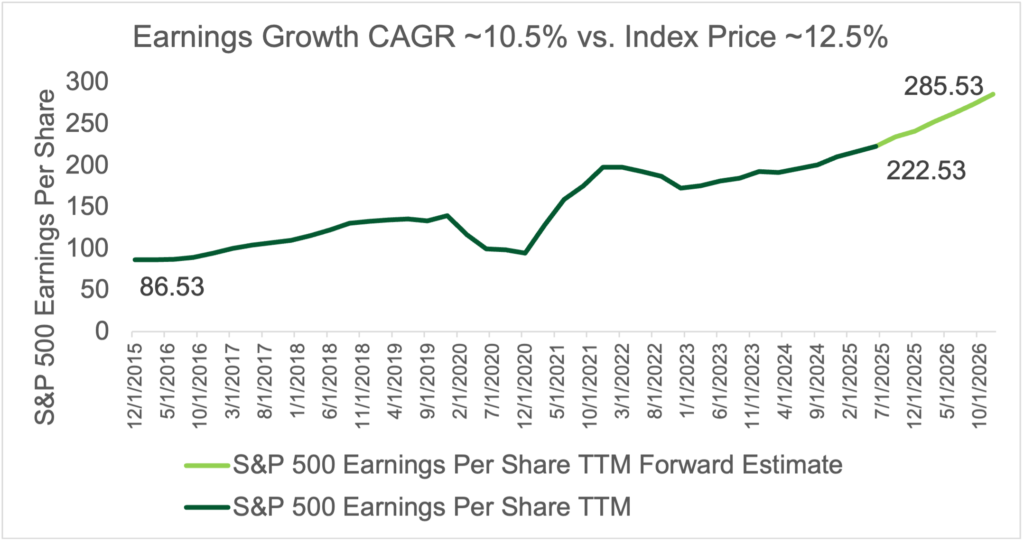
Despite frequent comparisons to the late-1990s dot-com bubble, earnings growth over the past decade has meaningfully contributed to the returns of the S&P 500 Index.9 This runs directly counter to what occurred in the late 1990s, when prices rose far faster than underlying fundamentals.

Source: YCharts, TFO Calculations, as of 12/31/2025, TTM through 6/30/2025, Estimates through 12/31/2026.

It is true that valuations have expanded, helping to explain the gap between earnings growth and price returns, but this expansion has occurred alongside rising profit margins. In 2025, profit margins for the S&P 500 exceeded 13%, well above the 10-year average. That may not sound dramatic, but when applied to more than $18 trillion in annual revenue, even small margin improvements translate into massive profits.10

Investors appear willing to pay more for earnings they view as durable.

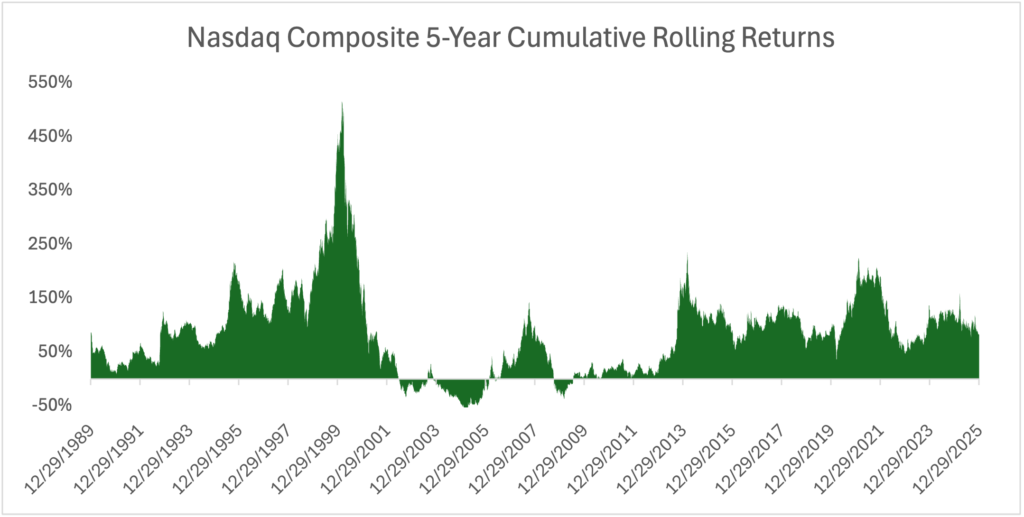
Looking specifically at the Nasdaq Composite Index, often cited as the epicenter of AI-related enthusiasm, today’s returns look nothing like the late 1990s when viewed through a wider lens.

Source: YCharts, FactSet, TFO Calculations, data as of 12/31/2025.

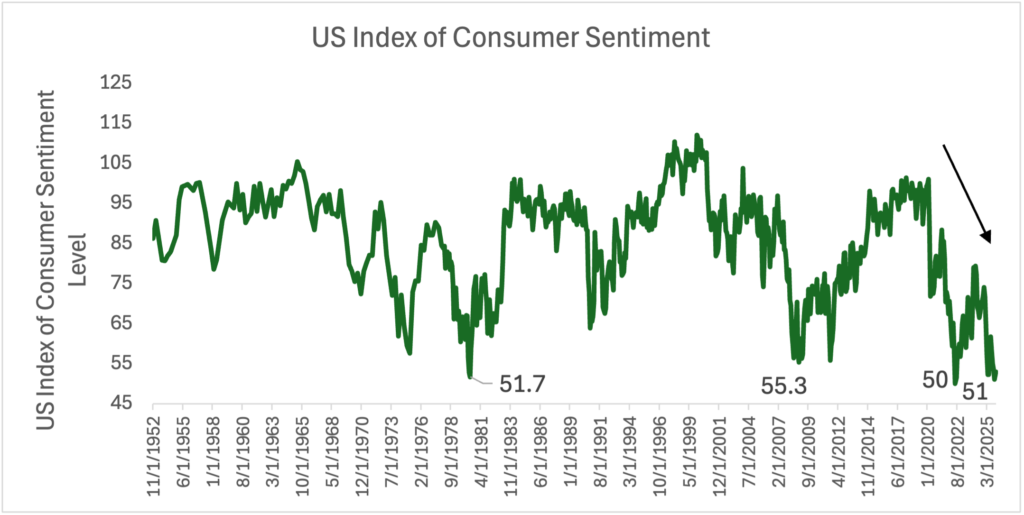
Consumer sentiment deserves special attention. Surveys tracking how consumers feel about the economy have fallen to levels at or below those seen during the global financial crisis, the inflation shocks of the 1970s, and even the depths of the pandemic.

Historically, these measures often acted as contrarian indicators, with sentiment bottoming near major market lows. Since 2020, however, sentiment indicators have been cut roughly in half at the same time equity markets around the world have reached all-time highs.11

Source: YCharts, University of Michigan, TFO Calculations, data as of 12/31/2025.

Political polarization, social media, and nonstop news cycles appear to be shaping perception in ways that did not exist in prior decades.

This divergence between numbers and narratives is the genesis of this series. It is not that headlines do not matter, or that they cannot influence behavior. It is that today’s news cycle is fundamentally different than the past. Our goal is to help separate what feels urgent from what truly matters.

What This Means for Long-Term Investors

No one knows what the future holds, and no one can reliably predict how investors will react when uncertainty becomes reality. Human psychology is not a forecastable input.

For long-term investors, the principles remain simple, even if execution is not. Stay invested if it aligns with your plan. Diversify across asset classes and global regions. Be mindful of costs and taxes, which compound quietly over time. And resist the urge to let short-term narratives override long-term discipline.

1 YCharts, FTSE Global All-Cap Index, data as of 12/31/2025

2 FactSet, fiscal Q3 2025 results

3 YCharts, Bloomberg U.S. Aggregate Index, data as of 12/31/2025

4 YCharts, Bank of America Merrill Lynch, Federal Reserve, as of 12/31/2025

5 YCharts, Bureau of Labor Statistics (BLS), as of 11/30/2025

6 Exhibit A., S&P 500 Index, as of 2025

7 YCharts, TFO Calculations, MSCI Country Index ETFs, data as of 12/31/2025.

8 YCharts, TFO Calculations, MAGS, IWC, VGK ETFs, data as of 12/31/2025.

9 YCharts, TFO Calculations, as of 12/31/2025, TTM through 6/30/2025, Estimates through 12/31/2026.

10 YCharts, FactSet, TFO Calculations, data as of 12/31/2025.

11 YCharts, University of Michigan, TFO Calculations, data as of 12/31/2025.

Advisory services provided by TFO Wealth Partners, LLC. We believe this information provided is reliable, but do not warrant its accuracy or completeness. This material is provided for informational purposes only.

Asset allocation and diversification do not assure or guarantee better performance and cannot eliminate the risk of investment losses. Past performance may not be indicative of future results. Therefore, no current or prospective client should assume that the future performance of any specific investment or strategy will be profitable or equal to past performance levels. All investment strategies have the potential for profit or loss. Different types of investments involve varying degrees of risk, and there can be no assurance that any specific investment will either be suitable or profitable for a client’s portfolio. There are no assurances that a portfolio will match or outperform any particular benchmark.

483cWP – 2026.01

white-dots white-dots

Ready to review your current wealth plan?

Getting started is easy. Set a time to talk.

Let’s Talkarrowarrow