Who Can Contribute
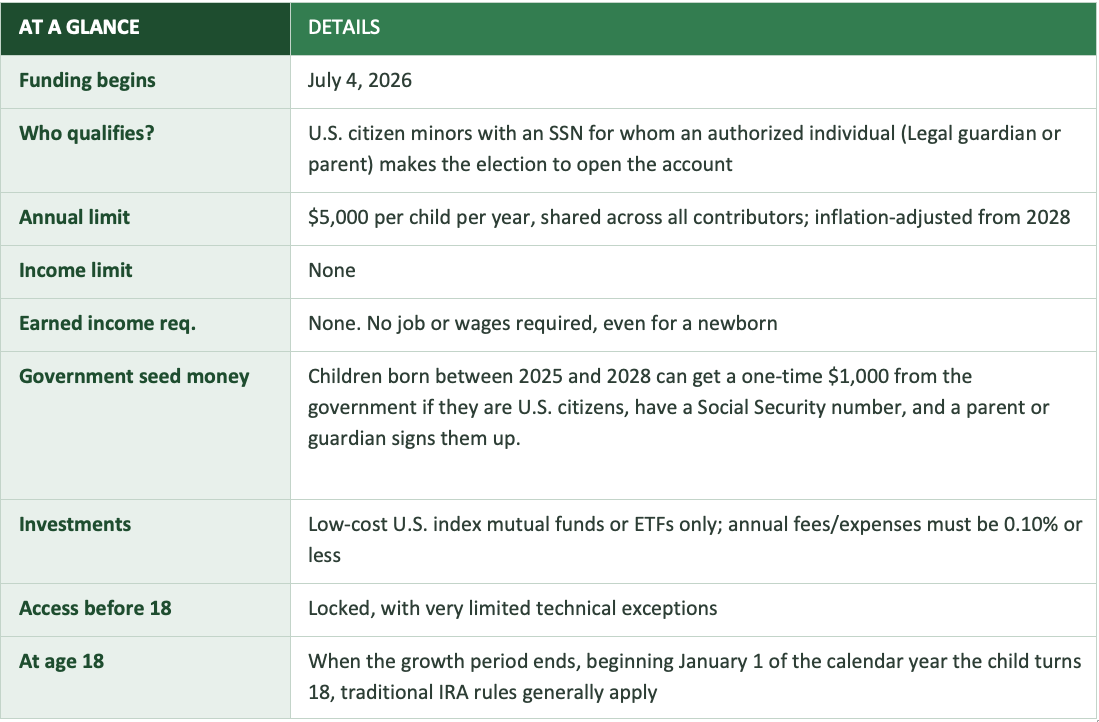
One of the most distinctive features of Trump Accounts is how open they are. Unlike virtually every other tax-advantaged account, there is no income limit and no earned income requirement during the growth period. A family can contribute the full $5,000 per year regardless of how much income or wealth they have.
- Parents, grandparents, relatives, friends, or any other person may contribute toward the shared $5,000 annual limit.
- Employers may contribute up to $2,500 per year per employee, not per child, toward the accounts of that employee’s dependents, subject to further IRS guidance. This counts toward the $5,000 limit but is excluded from the employee’s taxable income.
- Certain contributions, including the federal government’s $1,000 contribution for eligible children, do not count toward the $5,000 annual limit.
- Contributions to a Trump Account during the growth period do not count against the child’s traditional or Roth IRA contribution limits.
A Few Planning Considerations
1. The money is inaccessible until age 18
Treat the account as locked until age 18. Distributions during the growth period are not permitted, with only narrow technical exceptions under IRS rules. If there is any chance your family may need this money before then, a Trump Account is probably not the right place for it.
After age 18, the account becomes your child’s, and traditional IRA rules apply. Withdrawals for non-qualified purposes before age 59½ are subject to income tax and a 10% penalty. The financial education you provide between now and then is as important as the contributions themselves.
2. College savings and FAFSA deserve careful thought
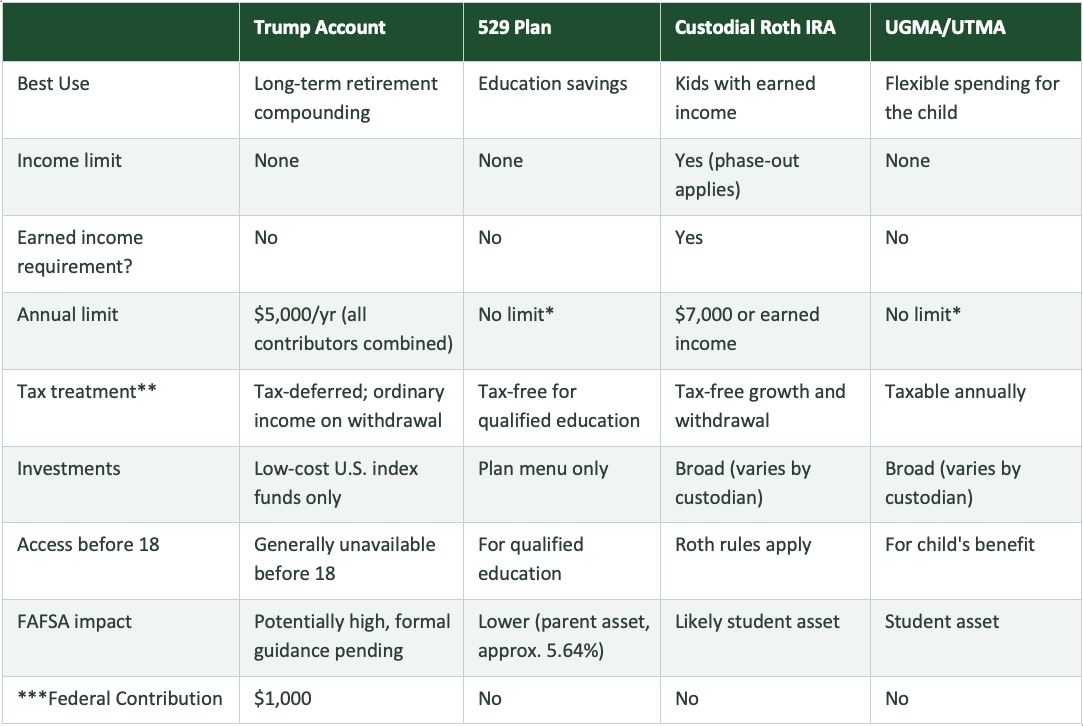
Because the account is owned by the child, many practitioners expect it could count more heavily against financial aid eligibility than a parent-owned 529 plan. A child’s assets are typically assessed at up to 20% on the FAFSA, compared to 5.64% for parent assets. For families who may qualify for need-based aid, a 529 plan is likely the better option for college savings. The Department of Education has not yet issued formal guidance on Trump Account FAFSA treatment, and we are monitoring this closely.
3. There is a Roth conversion opportunity
Once the child turns 18, a Roth conversion may become a meaningful planning opportunity. Done at the right time, typically when your child is out of school, financially independent, and in a low tax bracket, the conversion tax can be minimal. From there, the account is set up for decades of tax-free growth.
Timing matters. If a conversion happens while the child is still a dependent and subject to kiddie tax rules, some of the income could be taxed at the parents’ rate instead of the child’s. Because Trump Accounts follow traditional IRA rules after age 18, the tax treatment of withdrawals and conversions can be more nuanced than it first appears. Every family’s timeline is different and should be evaluated based on the child’s income, dependency status, and the family’s overall tax picture.
How to Get Started
Opening an account
- Register through an online application at TrumpAccounts.gov or file IRS Form 4547.
- Contributions open July 4, 2026. Only one Trump Account is permitted per child.
- There is no immediate deadline to open the account as long as your child remains eligible, but the election generally must be made by December 31 of the year the child turns 17. The sooner you open the account, the more time you have to contribute.
- Unlike a traditional IRA, contributions to a Trump Account cannot be applied to the prior year after the fact. All contributions must be made by December 31 of the calendar year they are intended for. There is no extension to the tax filing deadline.
- If you make regular annual gifts, note that contributions to a Trump Account may raise gift-tax reporting questions, even if no gift tax is owed. This is worth discussing with your estate attorney.
Charles Schwab Accessibility
All Trump Accounts must initially be opened through a trustee designated by the U.S. Treasury, not directly through a brokerage of your choosing. After the account is established, it can be transferred to another eligible custodian. As of now, it is unclear which brokerages will ultimately offer Trump Accounts to the public. Schwab itself has acknowledged on their website that it is not yet clear who will open accounts or where they will be held. We will confirm approved custodians and the process for TFO clients as guidance becomes clearer.
How It Compares to Other Child Savings Vehicles
Trump Accounts are not a replacement for any existing vehicle. They serve a specific purpose: long-term retirement compounding for a child, starting at birth. Depending on your family’s goals, tax situation, and time horizon, any one of these vehicles, or a combination of them, may make the most sense. Here is how they compare.