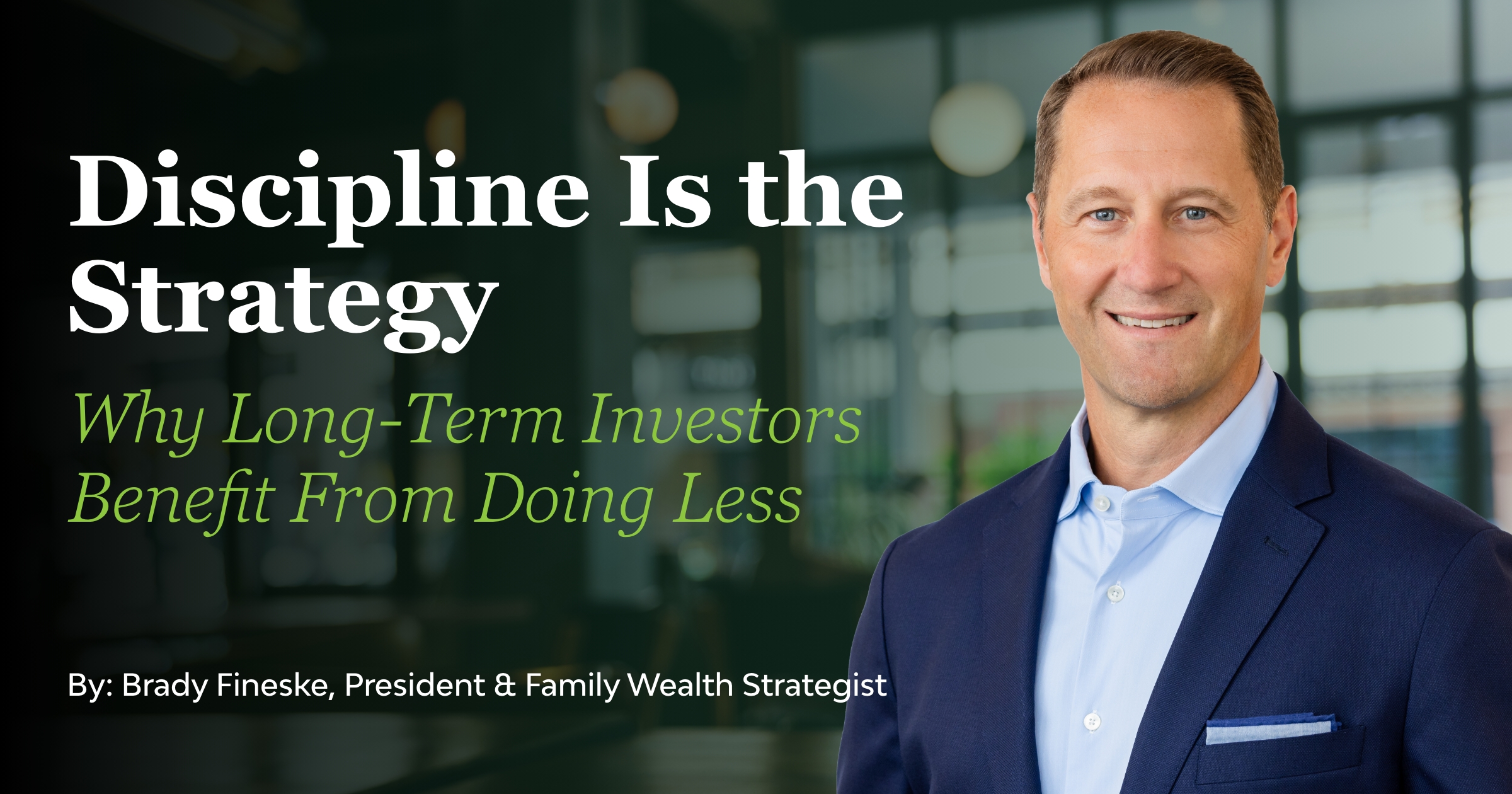

I recently had the opportunity to sit down with Gerard O’Reilly, Co-CEO and Co-Chief Investment Officer at Dimensional Fund Advisors, on The Wealth and Purpose Podcast.
At a time when headlines feel louder than ever, markets feel uncertain, and new “opportunities” seem to emerge almost daily, our conversation served as a timely reminder. A great advantage an investor can have is not access to better information or a more sophisticated strategy. It is the ability to remain disciplined when it matters most.
The Noise Isn’t New, But It Feels Louder Than Ever
If you turn on the news today, it can feel like the world is constantly on edge. Geopolitical tensions, elections, inflation concerns, and market swings dominate the conversation. For many investors, this creates a sense that action is required, that something must be done in response to what is happening.
During our conversation, I was reminded of a simple analogy. Imagine being on an airplane during turbulence. Some passengers immediately grip their seats and brace for impact, while others sit calmly, trusting the pilot and the process. Both groups arrive at the same destination, but their experience along the way is entirely different.
Investing works much the same way. Markets are constantly processing information and adjusting prices based on expectations for the future. Uncertainty is not an exception, it is the norm. The real question is whether you can stay seated when things feel uncomfortable.
Planning Matters More Than Predicting
One of the most important insights Gerard shared is that effective long-term investing does not begin with predicting what will happen next. It begins with preparation.
That preparation comes in the form of a thoughtful asset allocation aligned with your goals, your time horizon, and your ability to withstand volatility. At some point, markets will decline. That is not a possibility, it is a certainty. The role of a plan is to account for those moments in advance, so that when they occur, you are not forced into reactive decisions.
Many investors believe they understand their risk tolerance until they experience a real downturn. When markets fall 20 or 30 percent, the emotional response can be very different than expected. That gap between what we think we can handle and what we actually do is where discipline breaks down.
As Gerard put it, the goal is not to predict what will happen. It is to plan for what can happen.
The Hidden Cost of Constant Action
One of the most common mistakes we see is the urge to act, especially during periods of uncertainty. When markets decline, investors feel the need to make changes. When a particular asset class performs well, there is a temptation to chase those returns. When a new investment trend emerges, there is often a fear of missing out.
The challenge is that these actions are usually driven by short-term information that is already reflected in market prices. By the time something becomes widely known or discussed, it has already been incorporated into valuations.
Gerard shared a helpful way to think about this. Markets are forward-looking and incorporate the collective expectations of millions of participants. Reacting to headlines often means responding to information that is no longer new.
We see a similar pattern in everyday life. Sitting in traffic, switching lanes repeatedly in an attempt to move faster, only to realize that the lane you just left begins to move. The constant shifting creates the illusion of control, but rarely improves the outcome.
Markets as Aggregated Intelligence
One of the more interesting parts of our discussion was Gerard’s description of markets as a form of aggregated intelligence.
Every day, investors around the world are analyzing information, forming expectations, and acting on those views. The result is a dynamic system where prices reflect a wide range of insights and perspectives. This is what makes consistently outguessing the market so difficult.
Even with advancements in technology, including artificial intelligence, this fundamental dynamic does not change. Any perceived edge is quickly competed away as others act on similar information.
Where technology can provide value is not in predicting markets, but in improving how we implement strategies, serve clients, and operate more efficiently. The advantage is not in trying to be smarter than the market, but in executing a well-designed plan more effectively.
Evaluating Opportunities with Clarity
We also spent time discussing some of the areas that are generating the most questions today, including private markets, cryptocurrency, and other alternative investments.
Gerard offered a simple but important framework. When evaluating any investment, it is essential to understand where the returns are expected to come from. In public markets, the drivers are relatively clear. Companies generate profits, and investors participate in those outcomes. Bonds provide contractual cash flows through interest payments.
Other investments may not have the same underlying structure. In some cases, returns are largely dependent on the ability to sell the asset to someone else at a higher price in the future. That does not necessarily make them inappropriate, but it does require a clear understanding of the risks and trade-offs involved.
It is also worth remembering that public markets already provide access to a vast set of opportunities. Thousands of companies across the globe are continuously innovating and competing. Often, the opportunity set investors are seeking is already available to them.
Balancing Tax Efficiency and Investment Outcomes
Another topic we explored was tax efficiency, which has become an increasingly important part of the conversation for many investors.
While strategies designed to improve after-tax outcomes can be valuable, Gerard emphasized the importance of balance. Focusing too heavily on tax benefits at the expense of investment returns may lead to unintended consequences.
A slightly lower return, even if more tax efficient, may result in a significantly different outcome over time due to the power of compounding. The goal is not to ignore taxes, but to integrate them thoughtfully into a broader investment strategy without compromising long-term growth.
The Role of Guidance and Discipline
As we closed our conversation, I asked Gerard what advice he would offer to families stewarding wealth across generations.
His response was straightforward. Do not do it alone. Work with professionals who can help you build a plan, and once that plan is in place, stay disciplined in following it.
That discipline is what allows compounding to work over time. It is what helps investors navigate periods of uncertainty without making decisions that can derail long-term progress.
A Simpler Path Forward
In a world that constantly encourages action, optimization, and staying ahead of the next trend, it can feel counterintuitive to step back and do less.
But in many cases, that is exactly what disciplined, long-term investing requires.
The investors who achieve more consistent outcomes are often not the ones making the most decisions. They are the ones who are able to stay consistent, remain patient, and align their actions with a long-term plan.
If you’d like to listen to my full conversation with Gerard O’Reilly, you can find it on 🎧 [Apple Podcasts] | [Spotify] | [YouTube].
My hope is that this conversation serves as a reminder that while markets will continue to evolve, the principles that support long-term investing remain remarkably consistent.